Drive or cycle the length of one of France’s most famous wine producing regions. Taste the wines, tour the vineyards, even help bring in the harvest!
What is the Alsace Wine Route?
The Alsace Wine Route is a 170km (106 miles) trail that explores the rich history of this celebrated wine growing region in north-eastern France. Uncorked in 1953, it is a road and cycle route that runs from Wissembourg in the north to Thann in the south, following the eastern slopes of the Vosges Mountains, passing through countless idyllic Alsatian towns and villages. If you love your wine you’ll be in heaven; even if you don’t, it’s still one of France’s great road trips – a chance to take your time and discover beautiful landscapes, history and culture.
The Alsace Wine Route was conceived as a cycle route, which is how many people experience it. You’ll stay away from main roads and motorways, and be driving on single and dual lane D roads through the heart of the wine country. Cyclists use the dedicated cycle path (‘Véloroute du Vignoble d'Alsace’) that runs parallel to the road.
 The route is well signposted
Why the Alsace Wine Route is a must for wine lovers
“The character, imagination and sheer variety of Alsace wine is undeniable”, wrote the Guardian’s wine critic in 2025. But the wines of Bordeaux and Burgundy are much more well known than those of Alsace. That’s why a road trip on the Alsace Wine Route is such a voyage of discovery for wine lovers from the UK.
In total there are 51 Grand Cru vineyards along the route, mainly producing wines from the Reisling, Pinot Noir, Gewürztraminer and Pinot Gris grape varieties. Alsace wines are notable for being sold in slender, tapered green bottles, known as ‘flûte d’alsace’. This is why people sometimes consider all Alsace wines to be sweet, like the wines of the Moselle region, when actually they are often characterised for their dryness, full-bodied and aromatic nature.
The Alsace is a special region of wine production because of the variety and complex nature of the local soils (limestone, granite, clay and sandstone). Combined with the climate and topography, this is what helps to give the wines their flavour – what wine connoisseurs call the ‘terroir’.
Must-see stops in the Alsace wine region
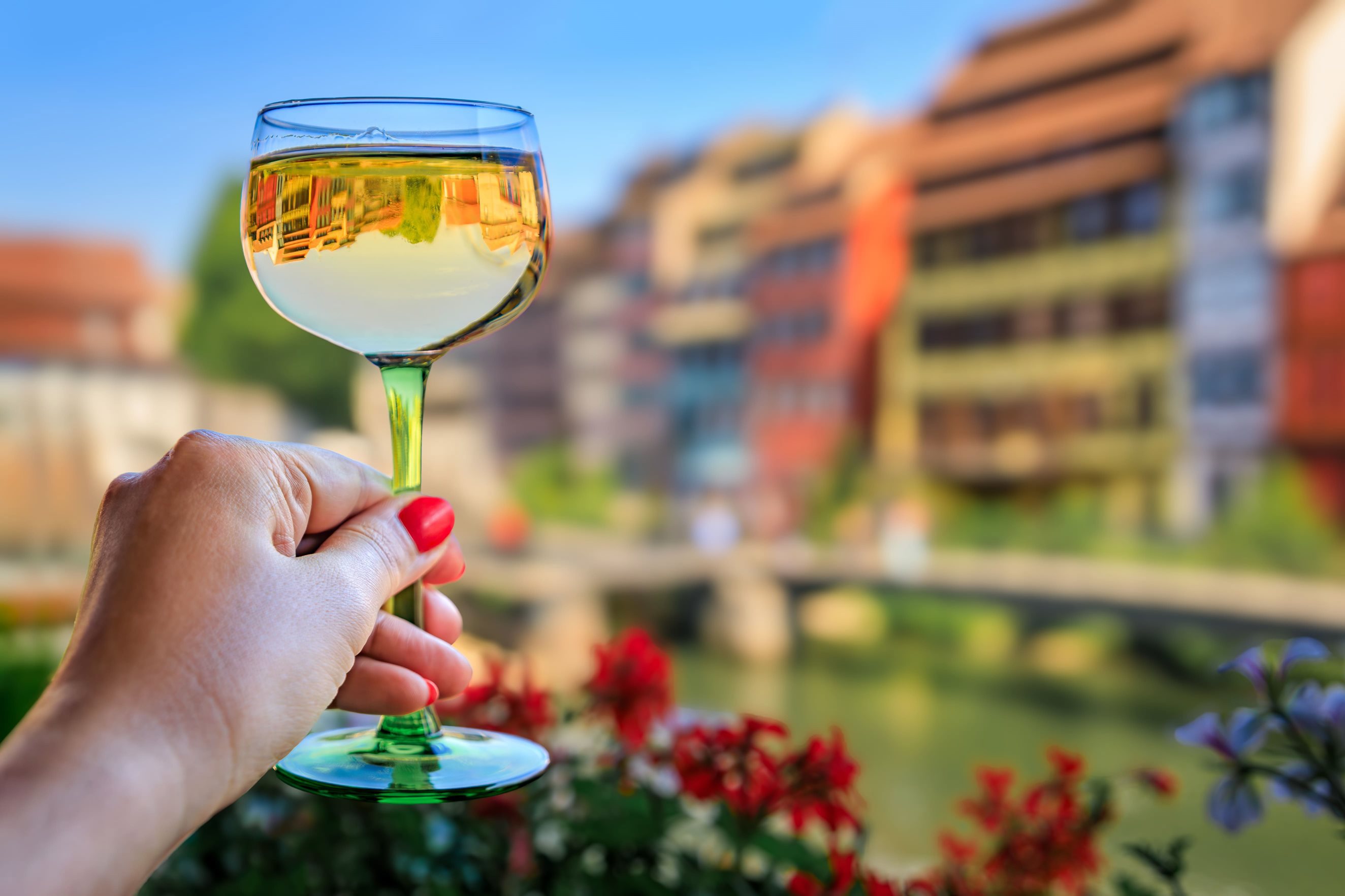 Toast the start of your trip with a sip (or two)!
Northern border vineyards – Wissembourg and Cleebourg
Stage 1: Wissembourg to Strasbourg
Your journey starts in the beautiful walled town of Wissembourg, near the border with Germany. Explore its medieval ramparts, peaceful riverside walks and cobbled squares. The 12th century Romanesque abbey is more than worth a visit, with a well preserved cloister and historic stained glass windows. Take a short walk from the town and you’ll discover your first rows of vines, which are actually in Germany! What a wonderful view you get of the Alsace plain you’ll shortly be driving through. A short drive away is the Cave de Cleebourg, a winery which acts as a collective for 200 winegrowers producing the signature grapes of the region. The cellar is open for tastings every day of the week and at weekends.
Northern Alsace – Strasbourg vineyards and medieval towns
Stage 2: Strasbourg to Barr (via Marlenheim and Obernai)
The historic city of Strasbourg is a lovely place to lay your head after your first day chasing the grape. But once you’re out on the road again in the morning, you’ll feel like the Wine Route has really begun – with the Vosges foothills, terraced slopes and farmland all around. Marlenheim and Obernai are the highlights on this stage – typical Alsatian towns, full of pastel-coloured half-timbered houses, floral window boxes and cosy bars, restaurants and wine cellars. You won’t have time to stop at every vineyard you see, as they start to become more frequent on the road to Barr, but some to look out for are Cave du Roi Dagobert, Domaine Mélanie Pfister and Domaine Schneider Jean Marc, which offers charcuterie and tasting experiences for €23 each.
Central Alsace – beautiful heart of the Route des Vins
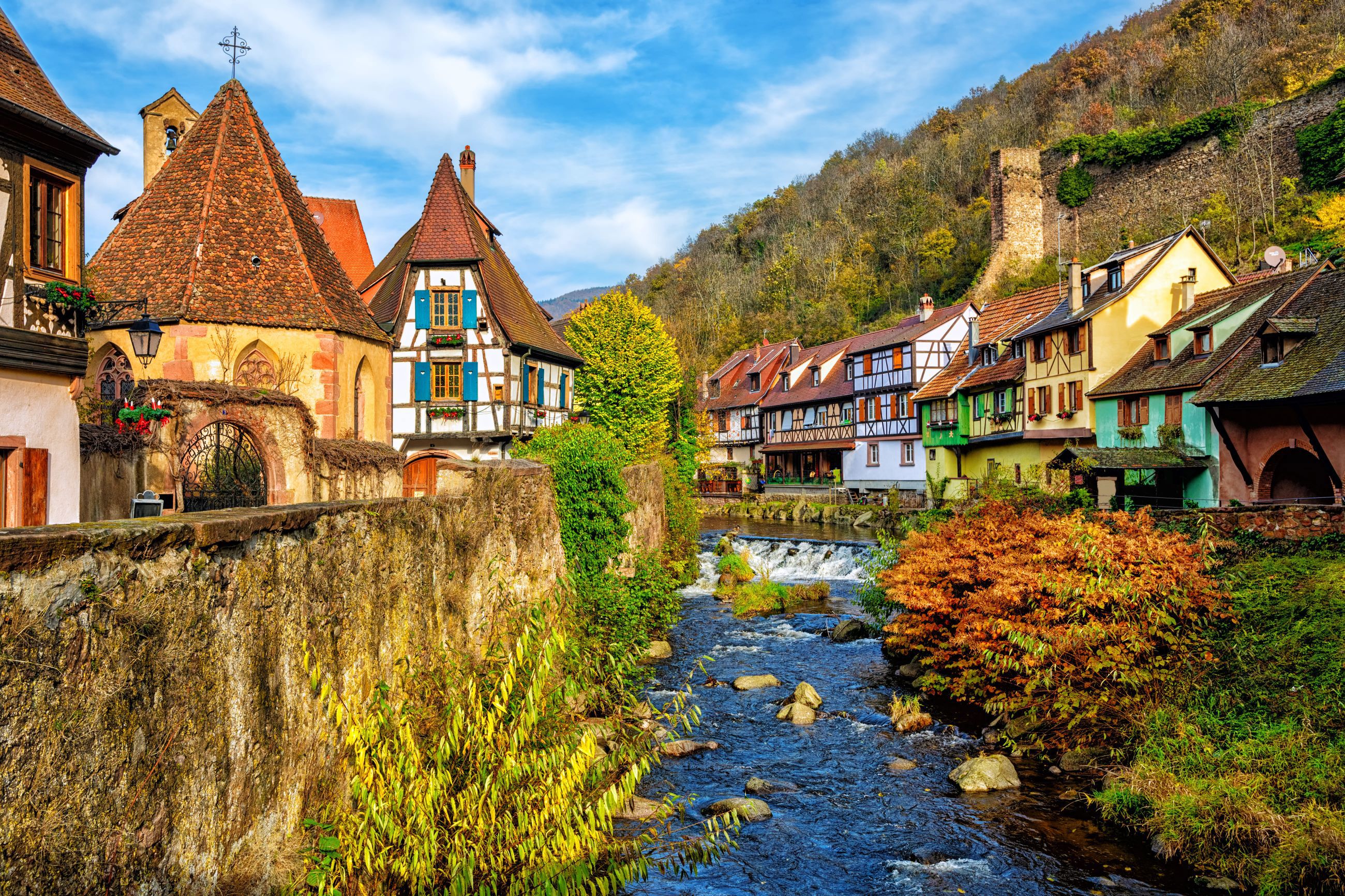 Kaysersberg, one of the loveliest towns on the Wine Route
Stage 3: Barr to Kaysersberg (via Ribeauville and Riquewihr)
Now you’re in the heart of the Route des Vins – vines as far as the eye can see, driving through sleepy villages with inviting cellars. Just off-route it’s worth making the trek up to the awesome Château du Haut-Kœnigsbourg, perched high on the mountains above the Alsace plains. The castle was a romantic ruin until the early 20th century when the German Emperor funded its restoration.
This part of the Alsace Wine Route, overflowing with vineyards, also boasts some of the region’s most picturesque towns and villages. Take your pick from Ribeauville, Riquewihr and Kaysersberg, each one like stepping into a Grimm fairy tale or Disney® film. Ribeauville is home to the Louis Sipp winery, and there are numerous wineries in the Kaysersberg valley open for tastings and tours. Kaysersberg was even voted France’s favourite village in 2017!
Colmar – Picturesque villages and Grand Cru heritage
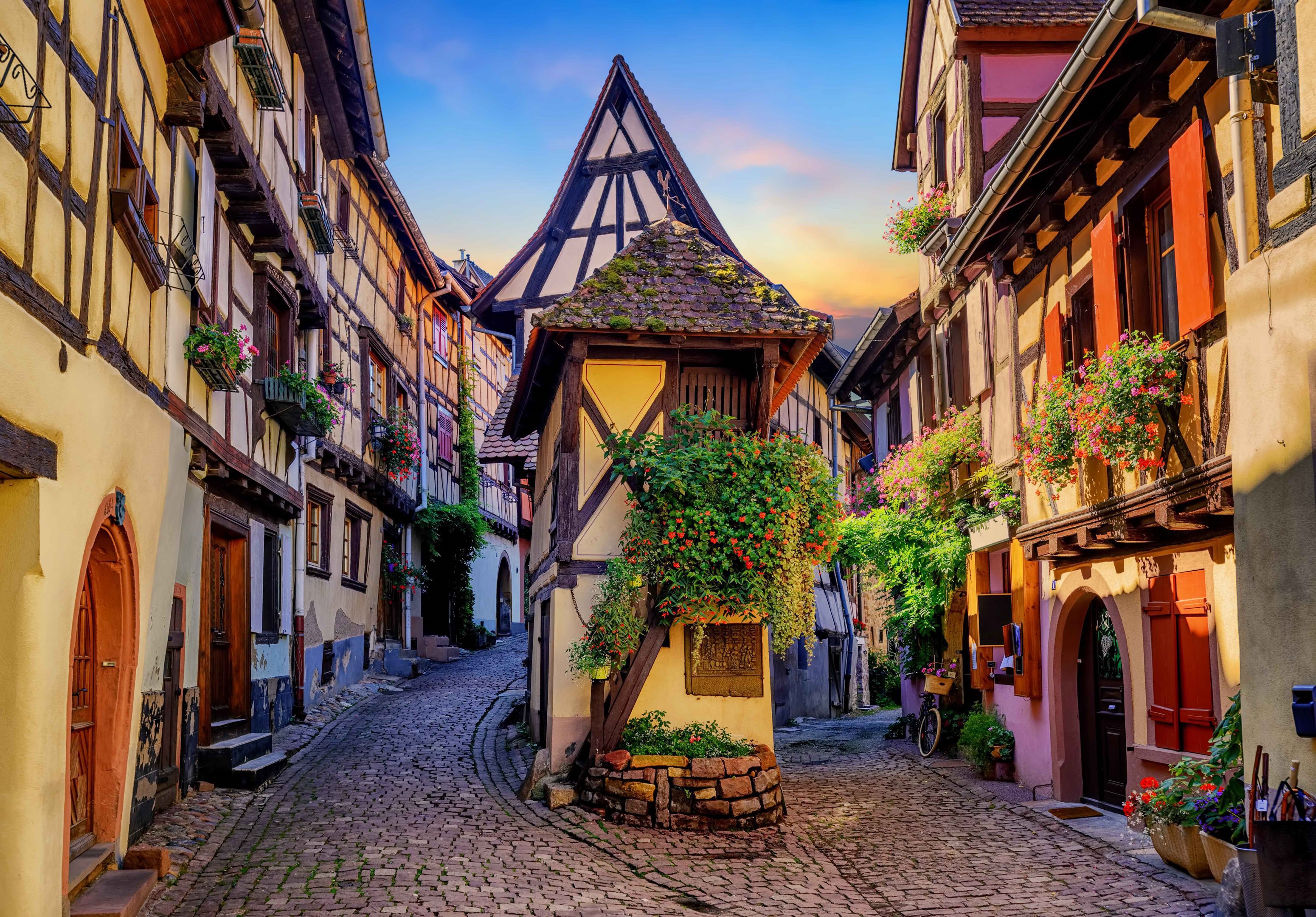 The enchanting village of Eguisheim
Stage 4: Kaysersberg to Eguisheim (via Colmar)
On paper, this stage on the Wine Route looks like a short day. But that’s because you don’t need to move far. Whether walking the enchanted cobblestone streets of Colmar, or tasting the full bodied wines of the Grand Cru vineyards in this area, this is a day to drink in the rich history and beauty of the Alsace.
Colmar is known as ‘Little Venice’ for its canals, bridges and watersides thronged with picturesque buildings, but if you haven’t yet had your fill of Alsatian architecture, rent a bike and cycle to nearby Eguisheim. It’s a magical place, partly because, apart from the circular road that surrounds it, the village is closed to car traffic. You’re free to wander the romantic cobbled lanes, between brightly coloured medieval houses, with their shutters and floral displays. It’s an idyllic spot for a wine tasting, at cellars like Leon Beyer on Place du Château Saint-Léon.
Southern Alsace – Thann and Soultzmatt
Stage 5: Eguisheim to Thann
The final leg of the Alsace Wine Route is a straightforward drive down the D83, passing typical Alsatian villages like Pfaffenheim and Issenheim. Turn right off the main road to head to Soulzmatt, a place famous for its natural water spring as well as its wineries. You can visit the bottled water plant, Sources de Soulzmatt, but maybe the wineries in the Noble Valley will be more tempting! Paul Kubler, Haag and Vins Nicollet are some of the estate names to look out for.
Your final destination is Thann – another pretty town that nestles between steep vines and thickly forested hills. The river Thur runs through it, and wine runs through this town. Visit the wine museum at the medieval ‘Witches Tower’ to learn about the history of wine production here. The vines grow at such a gradient in the Rangen vineyard overlooking Thann that winery workers sometimes need ropes to stay on their feet!
Experiences and wine tastings along the Alsace Wine Route
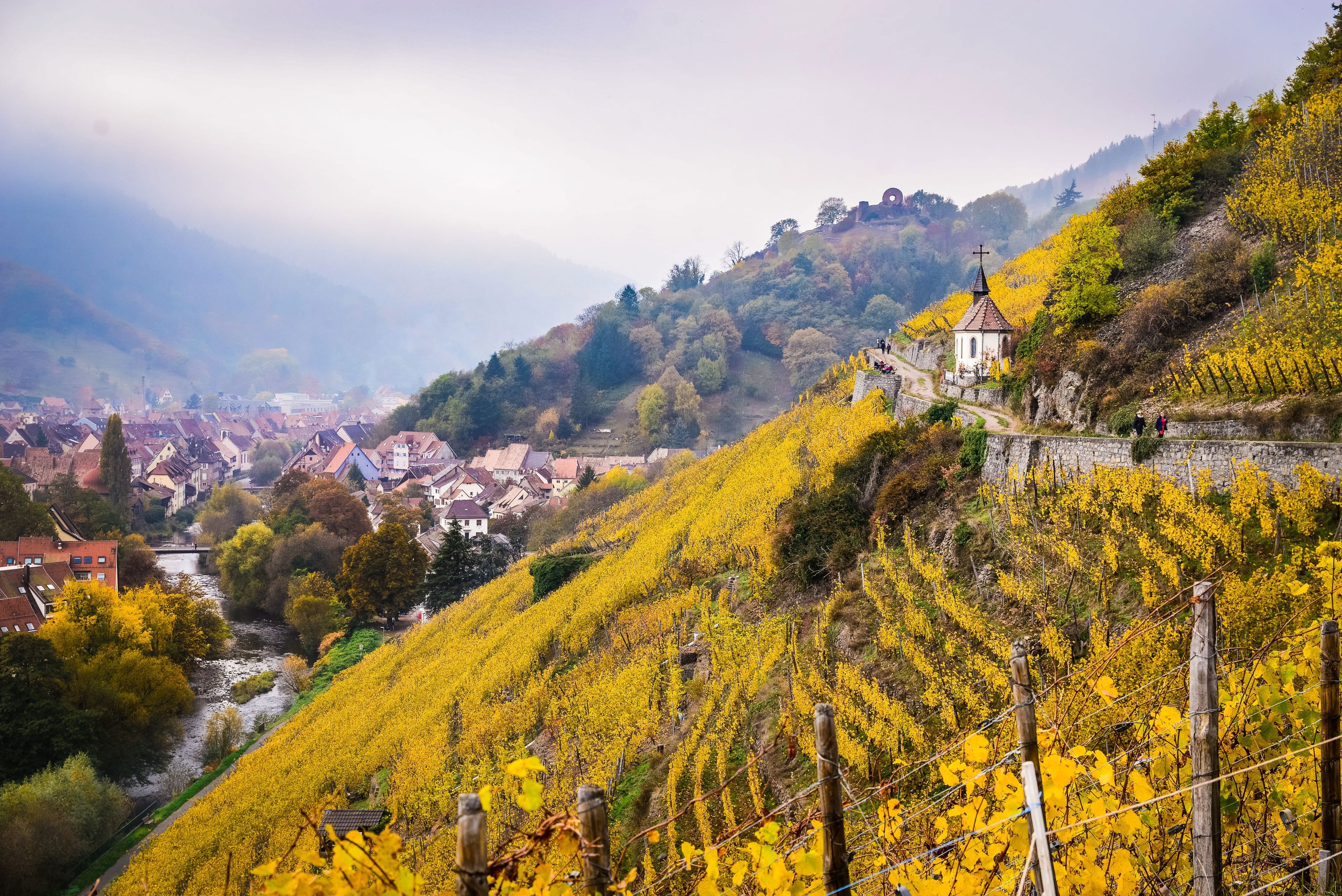 Vineyards overlooking Thann
You can see why cycling is often the favourite way to travel the Wine Route! Tastings are available at most large wineries in the area, as well as smaller boutique vineyards. If you want to visit several wineries at a time, it’s a good idea to base yourself in a town like Colmar or Obernai and hire bikes for the day.
For a truly unique Alsace experience, why not help bring in the harvest? Grape picking days are offered by many wineries along the route, when you’ll join the workforce, learn about grape picking techniques, have lunch in the vines and get a tasting too.
Wineries are part of the fabric of life in the Alsace. So many have stories to tell aside from the bottles they have produced. Winery Kuehn, for example, in the Kaysersberg Valley, houses the ‘Caves de l’Enfer’ (the caves of hell), the old wine cellars where local people sought refuge during the brutal Battle of Alsace in the winter of 1944-45. It’s an atmospheric place to visit, where candle-lit tastings are often held.
Plan your road trip along the Alsace Wine Route
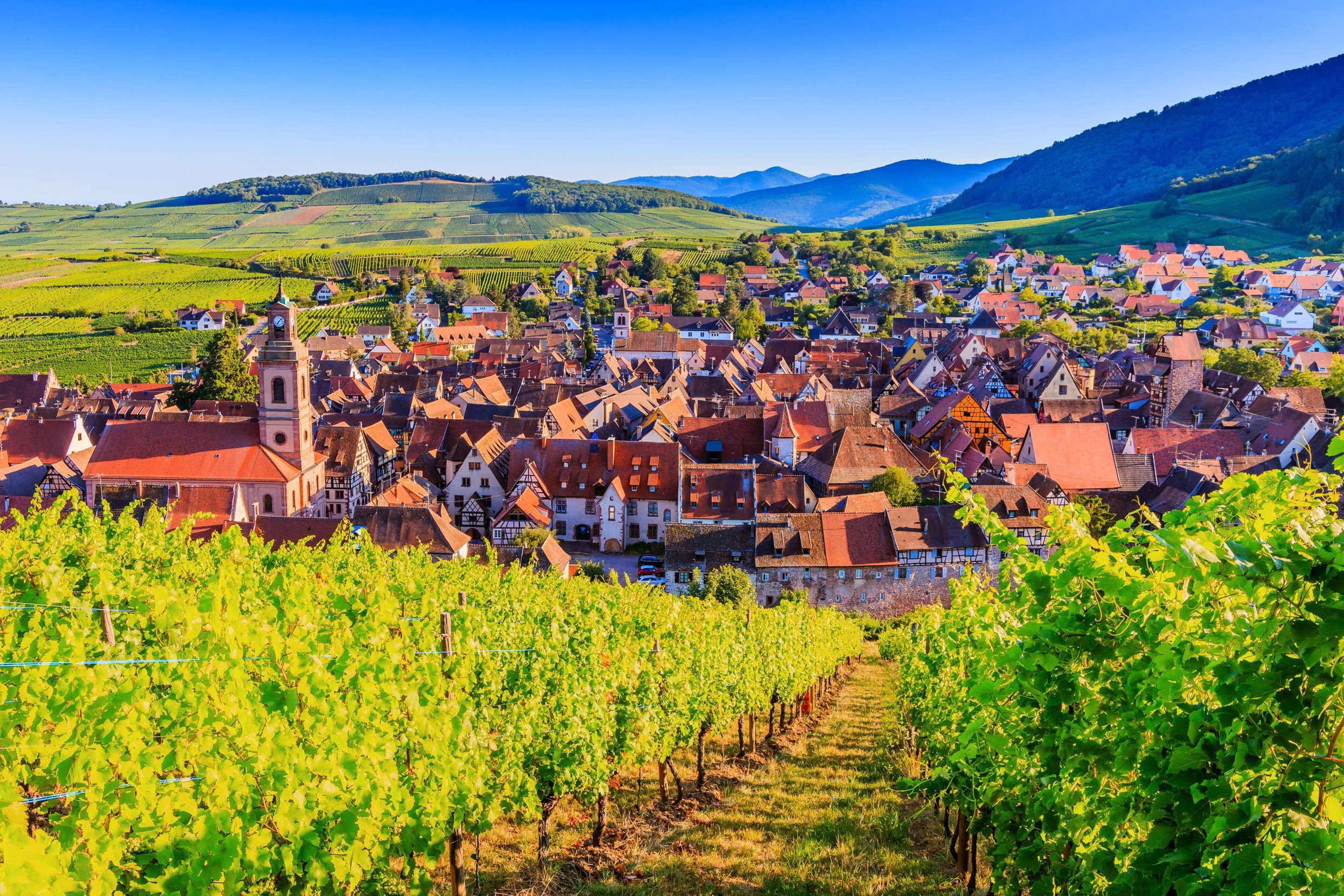 Riquewihr, another contender for Alsace’s prettiest place
How do I drive from Calais to the Alsace Wine Route?
The most direct route from the LeShuttle terminal at Calais to Wissembourg uses the A26 and A4 autoroutes, via Reims and Metz. This is a journey of 402 miles (648 km), taking 6 hours 15 minutes. Some people prefer to start their wine tour at Strasbourg, and drive to Colmar.
When is the best time of year to drive the Route des Vins?
Estates are usually open all year round for tastings, but to see the Alsace Wine Route at its best, visiting during the spring, early summer and early autumn is recommended. You’ll see the landscape at its most spectacular, especially when the sun is low in the sky. The peak summer months of June, July and August sees the Route des Vins at its busiest, and hottest. There will be more work going on at vineyards during the harvesting season, from late August to mid October.
Which itinerary is best for driving the Alsace Wine Route?
The full route from Wissembourg to Thann can be driven in a few hours, but this is the kind of trip where days can be spent covering a handful of miles. If you only have a couple of days, head for central Alsace and Colmar, where there is a greater density of wineries and you’ll see the finest towns and villages like Ribeauville, Riquewihr, Kaysersberg and Eguisheim.
Start planning your Alsace Wine Route adventure
It’s often said that you can taste the sunshine in the wine of the Alsace. Discover this for yourself on the Alsace Wine Route. Make sure you leave lots of room in the car on the 35-minute crossing from Folkestone to Calais, for the bottles you’ll be coming home with!


.jpeg?width=369&height=492&rmode=crop&ranchor=center&format=webp&quality=60&v=202411061544)


